Showing posts with label Charles Avery. Show all posts

Thursday, 29 December 2011

The landscape of the book

Just a quick post on another artist making books into sculptural works of art, Guy Laramee. His books works come in the form of two projects, Biblios and The Great Wall. Interestingly, Laramee conceptualises both projects through a story of civilisations, perhaps in a way that offers links to the work of altermodernist artist Charles Avery (see previous blog posts on Avery's The Islanders and Onomatopoeia).

Biblios is based around an ancient peoples called The Biblios. The Biblios invented words for the world around them, and so that they these words didn't die, they began to collect them in libraries. Moreover, the Biblios believed that words contained the spirit of the thing they designate.
The Biblios, as a people, die out, and according to the legend which Laramee writes, "It is generally agreed that Biblios dies under the weight of their knowledge". To read all of Laramee's commentary on Biblios, visit here.

The Great Wall, on the other hand, is about a civilisation from the future, a Chinese Empire of the 23rd Century keen to chronicle the histories of "The Great Panics" of the 21st and 22nd Centuries. The result was a vast encyclopaedia entitled 'The Great Wall'.

Laramee's work are intriguing objects, blending the bookwork as art, with landscape and fictional archaeology. Interestingly, Laramee's own artistic statement links his bookart projects to the supposed death of the book in the early 21st century. He goes on to say:

So I carve landscapes out of books and I paint Romantic landscapes. Mountains of disused knowledge return to what they really are: mountains. They erode a bit more and they become hills. Then they flatten and become fields where apparently nothing is happening. piles of obsolete encyclopaedias return to that which does not need to say anything, that which simple IS. Fogs and clouds erase everything we know, everything we think we are.

Friday, 23 December 2011

Altermodenist Fiction

I've recently completed editing The Routledge Companion to Experimental Literature, with Brian McHale and Joe Bray. As part of the collection, I wrote an essay on 'Altermodernist Fiction'. Obviously, I can't share that here, but I'm sure a few details won't do any harm!

Altermodernism is, according to Nicolas Bourriaud, the cultural milieu in which we now find ourselves. Bouriaud introduced this conception of the present epoch and its artistic movement in the most recent triennial at London art institute Tate Britain in 2009. The exhibition, which Bourriaud curated, continued the Tate's triennial project in showcasing the best in new British art. The exhibition featured artists such as Charles Avery, Peter Coffin, David Noonan amongst others.

In the exhibition catalogue, Bouriaud reveals that, to some extent, altermodernism has a literary inspiration: the writings of W. G. Sebald. As such, in my essay 'Altermodernist Fiction', I consider the features of contemporary experimental altermodernist fiction. As I explain, altermodernism is "defined by an implicitly politicised aesthetic resistance to globalisation, refusing standardisation, stability, or stasis". Moreover, altermoderist fiction (in line with Bourriaud's consideration of altermodernist art practices are characterised by the treatment of Form, Time, and Identity.

In the essay, I provide analysis of four texts: W. G. Sebald's The Rings of Saturn, Liam Gillick's Erasmus is Late, Brian Castro's Shanghai Dancing, and Charles Avery's The Islanders.

Tuesday, 26 July 2011

Onomatopoeia: The Port - Charles Avery

Onomatopoeia: The Port is the next phase in Charles Avery's Islanders project (launched with The Islanders, discussed here). The Prologue to this second book opens exactly as did the first: " I first came to the Island at the end of the great kelp rush..." Initially, Onomatopoeia's Prologue appears identical, but subtle variations start to arise, until eventually, the narrative becomes wholly original.


As readers, you could start with this book. However, the new additional narrative relies on readers' memory of details from The Islanders in order to unlock some of its narrative intricacies. For instance, towards the end of the Prologue, our narrator Only McFew informs us that as he began to explore the port of Onomatopy on the Island, he "exercised my new status as a tourist by standing in line to purchase a poke of moules and two eggs from Marcel's Casserole". Ordinarily, this is not particularly surprising information. Yet readers of The Islanders are aware of the infamy of the Island's eggs: In The Islanders, we learn that they are branded Henderson's eggs, and are "bitterly disgusting, yet ruinously addictive". The most any one can eat is three apparently, before they are "completely hooked". Indeed, Avery writes, "Many of the prospectors who came to the Island during the kelp rush did not prosper, but instead found ruin in the form of the eggs". Thus, at the end of Onomatopoeia's Prologue, when the narrative ends with the words, "I bit into my second egg", those readers who know of the eggs' power interpret the sense of foreboding these words contain, and the slippery downfall for Only McFew at which they hint...

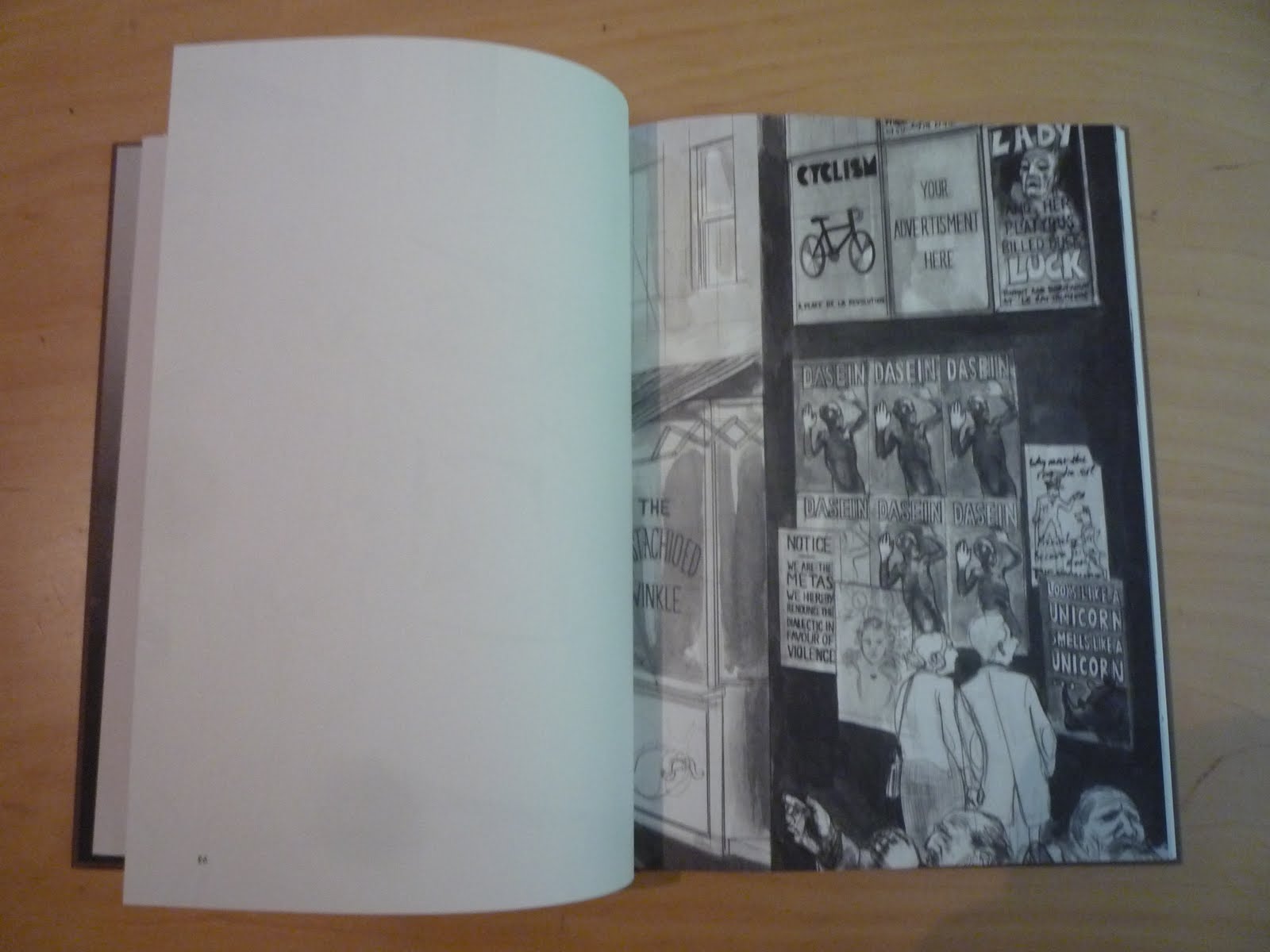
After the Prologue, Onomatopoeia really consists of Avery's stunning illustrations. It opens with a reproduction of Avery's large scale drawing of the port of Onomatopoeia (which featured in British Art Show 7, discussed on this blog here).


Since the original image is so large, the subsequent illustrations are essentially close-ups of areas of this initial picture, allowing the reader/viewer to really admire the detail of Avery's drawings.


Finally, echoing the structure of The Islanders, Onomatopoeia concludes with an Epilogue. As the final words of the Prologue implied, all is not rosey for Only McFew who states that he is "profoundly lost". He tries to write an inventory to keep his mind sharp, detailing the contents of his bag as well as "Self: I am called Only McFew (really!)" - Incidentally, this is troubling since this is the name Miss Miss understood, and seems unlikely to be the narrator's real name. In itself, this raises all sorts of questions for the reader concerning Only McFew's state of mind and well-being.

Enigmatically, the Epilogue to Onomatopoeia ends, "And finally I have started to wonder if, beyond the shops and bars and lights of Onomatopy, beyond the Plane of the Gods, where the defunct machines and litter are strewn, underneath the mountains and the flowers and the dust and the bones of the hunters, there is an island at all?"

Monday, 18 July 2011

The Islanders: An Introduction - Charles Avery

"I first came to the Island at the end of the great kelp rush, although I was not aware of that at the time. On the contrary, I had sought out this strange land with a view to being its discoverer."

So begins Charles Avery's The Islanders: An Introduction. The Islanders is, on one hand, a book, a fictional travelogue which catalogues a place called 'The Island' as encountered by the book's narrator. On the other, it is the first part of Avery's lifetime project, documenting the first four years of the Scottish artist's magnum opus.


The project itself is composed of large scale drawings, maps, sculpture, taxidermic specimens, and even a 3-D computer generated model of the Island (though Avery sees the latter "as a tool for me to use", rather than an artwork in itself). The objects and artifacts of The Islanders can be seen in gallery exhibitions such as the 2009 Tate Triennial Altermodern or the more recent British Art Show 7: In the Days of the Comet (reviewed on this blog here). And of course, they are documented in this book.

But The Islanders is more than an exhibition catalogue or archive of the artist's work: It is a fictional world of Avery's imagination, an altermodern archipelago, a new and unknown territory.


Having found the Island, the narrator prepares to leave, untying his boat, but is startled by a strange noise. Coming towards him is a beguiling young woman with whom he falls in love. The prologue concludes, "Through a series of misunderstandings, I came to believe her name was Miss Miss, and she, that I was called Only McFew. Miss Miss was to become my close companion and sponsor on the Island - although she consistently and firmly resisted any further advances. I remain to this day her devoted admirer."

Staying on the Island, perhaps because of love, perhaps because of curiousity and a calling to hunt and explore, Only McFew becomes familiar with the Island's inhabitants and its myths, as documented in the book. As readers, we learn about the various parts of the island such as the Avenue of the Gods, a lively market or bazaar; we're told of the prestigious role of the Hunter in Island society; we're introduced to the Island's peculiar (and strangely real) Gods; and we hear legends about its uncanny and surreal creatures.


In many ways, The Islanders is a conceptual exercise. It's about creating something and somewhere, it's about representation, its boundaries and its limitlessness. Even so, the book is strangely absorbing, and this is down to the detailed execution of Avery's drawings. They are undeniably masterful; the expressions on the faces of the Island's inhabitants, the Island and it's people's otherly familiarity...


...It's quite simply compelling... and intriguing. I am genuinely curious about what Avery will think up next for this imagined realm.

Interestingly, Avery seems to predict this. In an episode about the hunting and killing of an Aleph (a creature of the Island), Avery offers the following illustration:


The illustration depicts two 'Triangleland Bourgeoisie studying the head of an Aleph'. 'Triangleland' is the name for the other world - reality, in other words. Implicitly, then, there is an art gallery context being inscribed here, as though Avery is implying our own complicity in the project, the fact that the Island, however fictional, is something we lay witness to in his exhibitions.

The project continues with Onomatopoeia: The Port (which I subsequently blog about here), but in the meantime, Avery concludes The Islanders with a tantalising direct address: "I cannot tell you how this world really is - I have no idea - I can state only the facts as I perceive them. You must be satisfied with this or you must travel there yourself sometime, and see these beings in their natural environment, for this place is utterly subjective".

Monday, 7 March 2011

British Art Show 7


The British Art Show is organised every 5 years by Hayward Touring and showcases leading and emerging British artists. British Art Show 7: In the Days of the Comet (BAS7) is on at the Hayward Gallery at the moment, and so I took myself down there on Friday as a treat.

BAS7 featured 39 Artists exploring themes of history, temporal continuity, and parallel worlds. Overall, I found the exhibition invigorating. As is always the case, there were highs and lows in the collection for me. I'm going to use this blog to mention some of the stand-outs.


Christian Marclay - The Clock (Video) was one of the reasons I went to the exhibition in the first place. I was so excited about it, and it did not disappoint.


The Clock is a 24hr video that is composed of found video clips from countless films; each flim-clip or fragment features a reference (visual or verbal) to time. What's really cool about this work though is that as we watch these clips, narrating a disjointed story of sorts, the film-time unfolds in real time. As a viewer, you are both intensely involved in the bizarre story of the screen while being hyper-aware of how long you have been watching the piece. Your attention is somehow strangely split or perhaps it oscillates between the fictional and the real. I also really liked the fact that the film seemed to be littered with meta-comments about time.
I started watching The Clock at 12.10. It was hard to drag myself away.


Elizabeth Price - User Group Disco (Video) was the other video piece that I was really engaged by.


Set in a "fictional institution", this piece explores parallel worlds, while merging worlds through a clash of visual, verbal, and sonic register: images of kitsh porcelain and metallic utensils, corporate ppt text, and the music of A-ha (Take on Me). What I thought was really fascinating about User Group Disco was the way that it seemed to gather momentum, exposing the ideology of the corporate discourse and casting it in an unsettling light.


Charles Avery - The Islanders; Onomatopoeia also explored parallel worlds, this time a parallel world of the artist's own creation. And on a epic scale: The world of Onomatopoeia is a four-year project for the artist. The project features large scale pencil drawings, sculptures and installations. On display at BAS7 was an installation and a sculpture. It was the drawing that caught my eye.


I've seen Avery's work before at the Tate Triennial on Altermodernism, but this was the first time I'd seen his drawing. Its sheer size and detail really work to bring the world alive, and the comical yet grotesque figures who populate this world disturb and thrill the viewer in equal measure.


David Noonan - Untitled (Tapestry is the final work I'd like to mention here. Another large-scale item, Noonan's piece is a monochrome tapestry which collages images by overlaying or superimposing them.


The effect is both beautiful and haunting. The images and the worlds they represent are somehow coexistent, blending different periods and cultures within the space of a solitary tableau.


Ultimately (as you can probably tell), I loved British Art Show 7. Ironically given the theme, and felt particularly while watching The Clock, I wanted more time there!